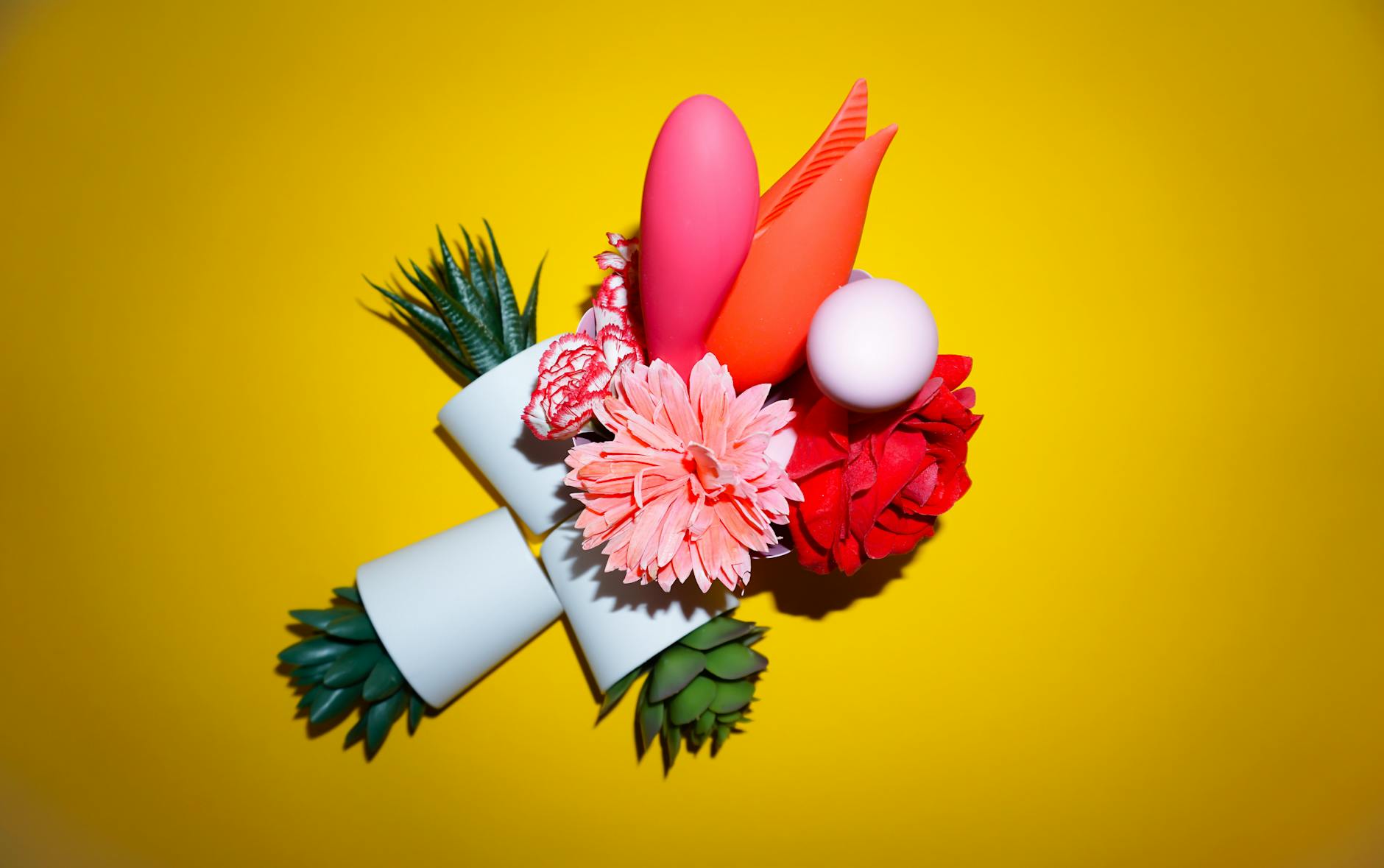
How to Use a Lemon Vibrator for Better Orgasms When You're on SSRIs
Let's be real: SSRIs save lives. They also flatten your orgasms. Not in a metaphorical way. In a neurochemical, measurable, deeply frustrating way that nobody warns you about when they hand you the prescription.
About 40-60% of people taking selective serotonin reuptake inhibitors report sexual side effects. That's not a small fraction. That's the majority. And most of the time, your doctor says "it usually improves" or "talk to your partner more," which is true but also wildly unhelpful when you're staring at a blank ceiling wondering if orgasm is something you'll ever feel again.
Here's what I want to tell you: your capacity for pleasure hasn't disappeared. Your nervous system has changed, and it needs a different kind of signal.
What SSRIs actually do to orgasm
SSRIs work by increasing serotonin availability in your brain. Serotonin is a mood neurotransmitter. It's great at making you less depressed. It's terrible at generating the kind of neurological cascade that leads to climax.
Here's the chain reaction: arousal happens in your sympathetic nervous system (the accelerator). Orgasm requires a quick burst of parasympathetic activation (the brake releasing). SSRIs smooth out the whole system, which is why your mood stabilizes. But that same smoothing means your nervous system can't spike the way it needs to in order to orgasm.
Additionally, SSRIs can blunt dopamine signaling slightly. Dopamine is the "reward" neurotransmitter. It's what makes pleasure feel like pleasure. When dopamine signaling is reduced, sensation becomes muffled. Touch that used to feel electric feels dull. Stimulation takes longer to build.
This is not psychosomatic. This is not in your head. This is your brain chemistry literally working differently.
Why vibration bypasses the SSRI block
Here's the part that changes everything: vibration doesn't rely on the same neural pathways that SSRIs are dampening.
When you use manual touch or partner touch alone, you're relying on your nervous system to amplify subtle sensation into arousal and then into orgasm. SSRIs have dampened that amplification. Your brain isn't turning up the volume the way it used to.
Vibration is different. It's not subtle. It delivers consistent, high-frequency stimulation directly to the clitoris, which has about 8,000 nerve endings concentrated in a tiny area. A lemon vibrator, specifically, uses air-pulse suction technology that creates a unique sensation profile. Instead of broad vibration patterns, suction stimulates nerves through pressure waves rather than simple oscillation.
This matters because suction activates a slightly different neural pathway than traditional vibration. It's not about forcing your nervous system to work harder. It's about sending a signal that's unmistakable and persistent enough that your SSRI-dampened system can still register and escalate it.
Many people on SSRIs report that they can't reach orgasm with a partner or with their own fingers. The same person can reach orgasm with a clitoral vibrator, specifically an air-pulse lemon vibrator, within minutes. It's not about motivation or arousal level. It's about signal strength.
Starting with the right intensity baseline
SSRI-induced orgasm delay is different from other kinds of sensation changes. You're not numb. You're not disconnected. You're just operating with a higher sensory threshold.
When you first try a lemon vibrator while on SSRIs, start at the lowest setting. Seriously. Not patterns 1 or 2. If your device has a beginning mode, start there. Most people on SSRIs find that the lower patterns are actually more effective than jumping to high intensity, because they allow the nervous system to build arousal incrementally without overwhelming the system.
Set aside 20-30 minutes. Not because you need it, but because you're not in a race. SSRIs can lengthen the time to orgasm. That's not a failure. That's information. Using that time to explore, to let sensation build, to actually feel what your body is responding to, is the shift that works.
When you're stimulating yourself with a lemon clitoral vibrator, focus on finding the specific area and pressure that creates a consistent "yes" feeling. SSRIs make it easy to miss subtle arousal cues, so you want a sensation that's unambiguous. Usually that's slightly off-center from the clitoral glans, because the suction is creating a broader field of stimulation than a point vibrator would.
The pattern-switching technique
One of the most effective strategies for SSRIs specifically is pattern variation. Many people on SSRIs hit a plateau where stimulation feels good but stops building. The sensation stays steady instead of escalating toward climax.
This happens because SSRIs reduce the kind of neural sensitization that normally happens during arousal. Your brain isn't getting progressively more excited. It's staying at a stable level.
With a lemon vibrator that has multiple patterns, you can break that plateau by switching patterns every 2-3 minutes. Stay with pattern 1 until sensation flattens. Switch to pattern 2. Let that settle. Then pattern 3. What you're doing is reintroducing novelty and change, which helps counteract the smoothing effect of the SSRI.
The switches don't need to be dramatic. In fact, small incremental changes work better than jumping from 1 to 5. You're not trying to shock your system. You're trying to gently keep escalating the signal.
Combining external stimulation with internal focus
SSRIs don't just affect clitoral sensation. They can also reduce the internal sensations that usually accompany arousal, like the feeling of tension building in your pelvic floor or the sense of blood flow and engorgement.
When you're using a lemon vibrator, you can deliberately add internal awareness to compensate. While you're receiving clitoral stimulation, place your other hand on your lower abdomen or inside your vagina if that feels good. The goal isn't additional direct stimulation. It's bringing your attention to the internal sensations that are happening, which your SSRI-dampened system might be too quiet to notice on its own.
Some people describe this as "turning up the volume" on sensations that are there but muted. You're not creating sensation. You're noticing it more acutely.
If you have a partner, they can do this too. While you're using the lemon vibrator externally, they can provide internal stimulation or simply hold pressure internally while you work the clitoral surface. The combination of internal presence and external vibration creates a richer signal profile.
Timing and the SSRI window
Most SSRIs are taken once daily, usually in the morning. Depending on the specific medication and your metabolism, peak plasma levels occur at different times. But there's a general pattern: the afternoon and early evening often see the lowest side-effect impact from SSRIs on sexual function.
If you're planning to use a lemon vibrator for pleasure, timing it 6-8 hours after you take your SSRI can make a measurable difference. You're not changing your medication. You're just working with your body's absorption cycle.
This is worth tracking for a few weeks. Some people find a specific time window where orgasm is notably easier. Once you notice that pattern, you can plan accordingly.
When to talk to your doctor
If you've been on the same SSRI for 3-4 months and sexual side effects aren't improving at all, that's worth discussing. Sometimes switching to a different SSRI (they have different sexual side effect profiles) or adding a secondary medication that counteracts sexual side effects (bupropion, buspirone, or sildenafil are common options) can help.
You don't need to choose between your mental health and your pleasure. Sometimes you do need a medication adjustment to get both. That conversation is not weakness. It's information.
What a lemon vibrator does is give you a tool right now while you're managing that conversation. It's not a workaround for medication changes. It's a way to have pleasure in your body today, on your current medication, while you figure out the longer-term strategy.
Building back trust in your body
One of the underestimated impacts of SSRI-induced sexual side effects is the psychological wear. You stop trying. Attempting orgasm feels like fighting your own body. You disconnect from pleasure not because sensation is gone, but because the effort feels futile.
When you use a tool specifically designed for your situation (a lemon clitoral vibrator that works through a mechanism SSRIs don't block), you rebuild a sense of "oh, my body can still do this." That might sound small. Psychologically, it's enormous.
The pleasure you have with the vibrator is real pleasure. It's not a compensation. It's not settling. It's you, on your medication, with a tool that actually works with your neurochemistry instead of against it.
FAQ
Can I use a lemon vibrator if I'm on multiple psychiatric medications?
Yes. If you're on an SSRI plus another medication, the principles are the same. Your neurochemical landscape is just more complex. Start at lower intensities, give yourself more time, and expect that it might take a bit more exploration to find the settings that work. If you're concerned about any medication interaction with sexual response, your psychiatrist is the person to ask. But the vibrator itself is safe.
How long does it usually take to orgasm with a lemon vibrator when you're on SSRIs?
It varies, but most people report 10-20 minutes once they find the right pattern and positioning. That's longer than before the medication, but it's much faster than the hour-plus many people experience before trying a vibrator. After 3-4 weeks of regular use, some people find the time shortens as their system recalibrates and stops bracing against the sensation.
Will using a vibrator make my SSRI side effects worse?
No. A lemon vibrator doesn't change your medication levels or brain chemistry. It's an external tool providing stimulation. Using it won't intensify sexual side effects from the SSRI. If anything, successfully reaching orgasm can reduce some of the anxiety and frustration that compounds sexual side effects.
Can I use a lemon vibrator with a partner if I'm on SSRIs?
Absolutely. Some people find it easier to orgasm with a partner present and a lemon vibrator in hand than either alone. Others find they need privacy and mental space. There's no rule. What matters is what your nervous system needs. If you want to use it with a partner, communication is key. You might say: "I can reach orgasm more reliably with this tool. It's not about you. It's about my medication. Can we use this together?" Most partners are relieved because it shifts from "we're failing" to "here's a solution."
What if I switch SSRIs or stop taking them? Will the vibrator still work?
Once your medication changes, your baseline arousal and orgasm capacity will likely shift. Some people who switch SSRIs find their sexual function improves significantly. If that happens, you might find you need less intense stimulation or can orgasm more quickly. A lemon vibrator will still feel good. You'll just be using it in a different neurochemical context. It's still a tool for exploring pleasure, whether you're on medication or not.
Is it normal to feel numb or disconnected even with a lemon vibrator at first?
Yes. Numbness from SSRIs isn't just physical. It's emotional. You might feel sensation from the vibrator but not feel "turned on" in the way you used to. That's the dopamine dampening. Keep going. Many people report that after 3-4 sessions, the emotional connection to pleasure returns even as the physical dampening remains. Your brain is learning that pleasure is possible again. That relearning takes a few cycles.
The long view
SSRIs that work for your mental health deserve to stay. Your pleasure also deserves to stay. A lemon vibrator isn't a compromise between those two things. It's a technology that acknowledges how your brain actually works on medication and builds around that reality.
You're not broken. Your nervous system is just operating under different chemical rules. Once you understand those rules, working with them becomes straightforward. A clitoral vibrator, specifically one using air-pulse suction technology like the Lem, handles those rules elegantly.
Your medication helps you show up for your life. Your vibrator helps you show up for your pleasure. Both can be true.